
How Sybase Database Support and Consulting Keep SAP ASE Running Past 2027
A claims engine at a regional insurer. A settlement system at a brokerage. A dispatch platform at a utility. A billing run that’s closed the books every night since the early 2000s. Plenty of business-critical systems in the US still run on Sybase, and most of them still run well.
What’s changed is the calendar around them. SAP, which bought Sybase in 2010, publishes firm end dates for mainstream maintenance on each release, and the people who know these systems best are getting harder to hire. That leaves two kinds of help most Sybase shops end up needing. Sybase database support keeps today’s environment stable and fast. Consulting answers the bigger questions, like whether to upgrade or migrate and how to get there without downtime the business notices.
This guide explains how the two differ, what each one covers, the maintenance dates that should shape your plans, and how to tell which kind of help you need right now.
Key Takeaways
- Different jobs: support runs the database day to day; consulting plans and delivers change.
- ASE 16.0 has a firm date: SAP lists December 31, 2027 as the end of mainstream maintenance for ASE 16.0, and December 31, 2030 for ASE 16.1.
- End of maintenance isn’t end of life: the database keeps working, but standard patches and security fixes stop.
- ECC on ASE has two clocks: the database release and SAP Business Suite 7 maintenance both point to 2027.
Sybase in 2026: Who Owns It and What’s in the Family
Sybase is part of SAP. SAP acquired the company in 2010, and over the following years its products took SAP names, though most DBAs and job posts still just say “Sybase.” The family has four main members:
- SAP Adaptive Server Enterprise (ASE): the transactional database, formerly Sybase ASE, and what most people mean by “Sybase.” It’s common in finance, telecom, healthcare and government.
- SAP IQ: a columnar analytics database built for fast queries across very large data sets.
- SAP Replication Server: moves data between databases in near real time, often for warm standby or reporting copies.
- SAP SQL Anywhere: an embedded and mobile database used in remote sites and packaged software.
SQL Anywhere and ASE share a heritage but serve very different workloads, so they’re rarely managed the same way. ASE also sits underneath many SAP ECC and SAP BW systems, which matters for the dates below. Planning around those dates is a big part of what Sybase consulting services handle today.
The Maintenance Dates Behind Every Sybase Decision
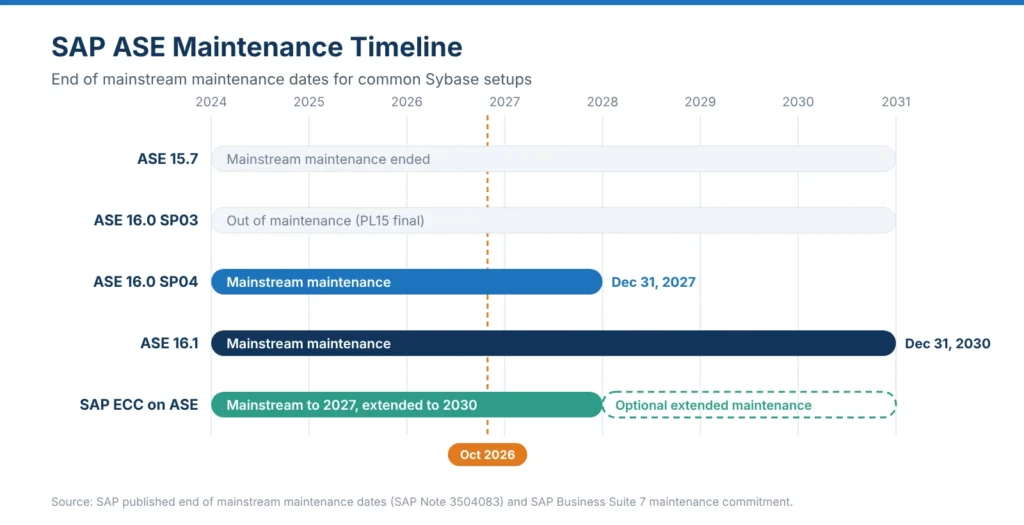
Every Sybase plan should start with SAP’s end of mainstream maintenance (EoMM) dates, because they decide how long your release keeps getting standard fixes. SAP tracks them in SAP Note 3504083. ASE 16.0 was originally due to leave mainstream maintenance at the end of 2025; SAP later moved that date to the end of 2027.
| Release | End of mainstream maintenance | What it means for you |
|---|---|---|
| ASE 15.7 | Already passed | No new patches; plan an upgrade or a migration |
| ASE 16.0 SP03 | Out of maintenance; PL15 was its final patch level | Move to SP04 to keep receiving fixes |
| ASE 16.0 SP04 | December 31, 2027 | About 14 months of standard fixes left from late 2026 |
| ASE 16.1 | December 31, 2030 | A longer runway on the same platform |
| SAP ECC (Business Suite 7) | End of 2027, with optional extended maintenance to end of 2030 | ECC on ASE needs a plan for both the ERP and its database |
SAP has been clear that these dates aren’t a shutdown. In its announcement on the next generation of ASE and IQ, SAP committed to supporting Sybase products past the original 2025 date and set December 31, 2030 as the end date for ASE 16.1. It also pointed out that EoMM dates had often been misread as end of life.
What End of Mainstream Maintenance Actually Means
It means SAP stops shipping new patches and support packages for that release. The database doesn’t stop working. Under SAP’s maintenance phases, a release that leaves mainstream maintenance moves into extended maintenance where SAP offers it, or into customer-specific maintenance, where SAP can still help with your problems but no longer delivers new fixes for everyone.
For a DBA, the biggest practical change is security. A vulnerability found after the cut-off won’t get a standard fix, and auditors in regulated industries tend to notice. That’s why the months before an EoMM date are the right time to act, not the months after it.
Why SAP ECC on ASE Runs on a Double Deadline
Companies running SAP ECC on ASE face two clocks at once. SAP’s Business Suite 7 maintenance commitment ends mainstream maintenance for ECC in 2027, with optional extended maintenance to 2030. And since S/4HANA runs only on SAP HANA, moving to it means ASE can’t stay on as the ERP database.
Until that move happens, ASE still has to run cleanly underneath ECC. And the move itself is a full ERP project, not a simple database swap.
What Sybase Database Support Covers
Sybase database support is the ongoing work that keeps a Sybase environment healthy and available every day of the year. It’s usually delivered as a managed service with agreed response times, and it’s where Sybase DBA support lives. A good support arrangement covers four areas.
Monitoring and Incident Response
Around-the-clock monitoring catches problems like a filling transaction log or a stalled replication queue before users notice them. When something does break, a named DBA responds within the agreed window and works the issue through to root cause, not just to a restart.
Backup and Recovery
Support teams schedule database and log dumps and test restores on a regular cycle. They also look after Replication Server warm standby or ASE always-on setups, so failover works when it’s needed. A backup nobody has restored is only a hope.
Patching and Version Upkeep
Applying support packages and patch levels on schedule matters more as EoMM dates get closer. Each patch level is tested against your applications first, then rolled out in a planned window with a way back if something misbehaves.
Performance Tuning
Most ASE slowdowns trace back to a few familiar causes: stale statistics, fragmented indexes, undersized caches or a query plan that changed after a data spike. Ongoing tuning keeps response times steady as data grows, so slow batch jobs don’t become the new normal.
Who does this work? Some organizations keep an in-house DBA. Many now lean on SAP Sybase DBA experts from an outside partner, because experienced ASE specialists have become harder to find and a single DBA can’t cover every night and weekend.
What Sybase Consulting Services Handle
Sybase consulting services are project work. They answer a specific question or deliver a specific change, then hand the environment back to whoever supports it. Typical SAP Sybase consulting engagements include:
- Assessments and roadmaps: inventorying every instance and its dependencies, then ranking risks and options by cost and urgency.
- Upgrades: moving from 15.7 or 16.0 SP03 to 16.0 SP04 or 16.1, with compatibility testing for stored procedures and client drivers.
- Migrations: moving ASE workloads to SQL Server or PostgreSQL, on premises or in the cloud.
- Architecture and cost reviews: redesigning high availability and consolidating underused servers to cut license and hardware spend.
Sybase database consulting differs from support in one important way: it has a defined scope and an end date. You know what you’ll get and when.
The best Sybase consulting experts also bring pattern recognition. They’ve already met the undocumented trigger and the replication route nobody remembers creating, so those surprises turn up during the assessment instead of during cutover.
Sybase Support vs Consulting at a Glance
Support keeps today’s system running; consulting changes it. Here’s how they compare side by side.
| Sybase support | Sybase consulting | |
|---|---|---|
| Main goal | Keep the current environment stable and fast | Plan and deliver a change |
| Timeframe | Ongoing, usually a monthly or annual contract | A project with a start and an end date |
| Typical work | Monitoring, patching, backups and tuning | Assessments, upgrades, migrations and redesigns |
| Measured by | Uptime and incident response times | Delivery on schedule with no data loss |
| Who leads it | DBAs on rotation, often 24×7 | Senior architects and migration specialists |
| When you need it | Every day the database runs | When something has to change |
How to Tell Which Kind of Help You Need
Most organizations need both at some point, but the trigger tells you where to start.
Start with support if:
- The one person who understands your ASE servers is retiring or has already left.
- Incidents are handled ad hoc, with no on-call coverage overnight or at weekends.
Start with consulting if:
- You’re still on 15.7 or 16.0 SP03 and need an upgrade path before the end of 2027.
- Leadership wants a costed decision on whether to stay on ASE or move off it.
If both lists sound familiar, sort out support first. A migration plan built on an unstable environment tends to slip, because the team spends its time firefighting instead of testing.
Questions to Ask Before Hiring a Sybase Partner
The right partner answers these plainly and puts the answers in writing.
- Which Sybase products do your DBAs work with every week? Breadth matters if you run IQ or Replication Server alongside ASE.
- What’s your response time for a production outage, and is it in the contract? A promise that isn’t in the SLA isn’t a promise.
- Can you support SAP ECC or BW on ASE, not just standalone databases? Business Suite systems need coordination with SAP Basis teams.
- Will you give an honest view on staying versus migrating? A partner that only sells one answer isn’t really advising you.
Frequently Asked Questions
Is Sybase still supported in 2026?
Yes. SAP lists mainstream maintenance for ASE 16.0 until December 31, 2027 and for ASE 16.1 until December 31, 2030. Older releases such as 15.7 are already past their end dates.
Is Sybase the same as SAP ASE?
Yes. SAP ASE is the current name for Sybase Adaptive Server Enterprise, which SAP took over when it acquired Sybase in 2010.
What does a Sybase DBA do?
A Sybase DBA monitors servers, runs backup and recovery, applies patches and tunes performance. They also respond to incidents and keep replication healthy.
Should we upgrade to ASE 16.1 or migrate off Sybase?
It depends on how long the application needs to run and how deeply it relies on ASE-specific code. ASE 16.1 buys time to 2030; a migration removes the deadline but takes longer to deliver. An assessment that maps dependencies usually makes the choice clear.
Can third-party support replace SAP maintenance for Sybase?
It can keep an out-of-maintenance release running with expert troubleshooting and security hardening, though new SAP code fixes come only from SAP. Many organizations use it as a bridge while they plan an upgrade or a migration.
Should support and consulting come from the same provider?
It isn’t required, but it helps. A provider that already supports your environment knows its quirks, so assessments start faster and fewer surprises turn up during upgrades.
Conclusion
Sybase isn’t disappearing overnight, and neither are the systems built on it. What’s changed is the timeline. With mainstream maintenance for ASE 16.0 ending in December 2027, the next 14 months are the window to stabilize what you run and decide what comes next.
Treat the two kinds of help as partners. Sybase database support keeps the lights on, while consulting plans the next move and carries it out. When one partner, such as RalanTech, handles both, the team that knows your servers today is the same one shaping where they go.